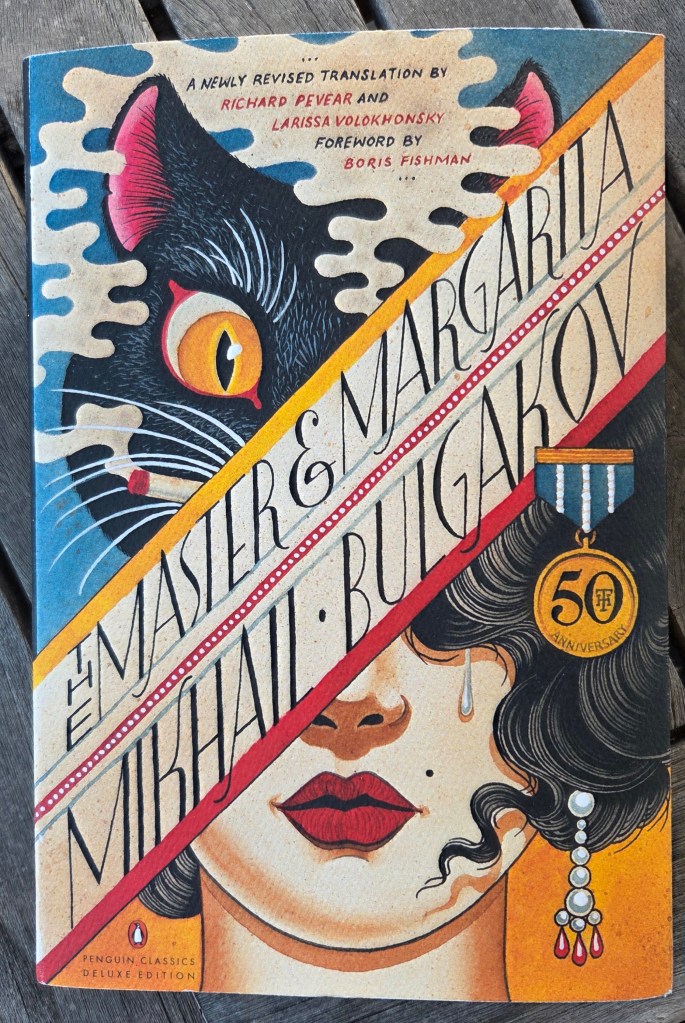


I woke up at 3 a.m. still thinking about chapter 2. About Jesus and his blithe honesty even when Pilate is trying to feed him answers that could save him from the cross, and even more so about Pilate, that poor asshole, in the throes of indecision. I didn’t expect to have empathy for him, but the depth of his pain and confusion is palpable. I lay awake thinking about his inner turmoil, and considered the angel on one shoulder, the devil on the other.
The angel:
At that moment a swallow swiftly flitted into the colonnade, described a circle under the golden ceiling, swooped down, almost brushed the face of a bronze statue in a niche with its pointed wing, and disappeared behind the capital of a column. It may be that it thought of nesting there.
During its flight, a formula took shape in the now light and lucid head of the procurator.
His decision? No death sentence for Jesus, “the vagrant philosopher,” but instead (since he’s “mentally ill”) — “putting him under confinement in Stratonos Caesarea on the Mediterranean–that is, precisely where the procurator’s residence was.”
He’s decided to set him free, and even wants him near. Because Jesus recognized his pain and made his crippling migraine disappear? Because he knew Pilate just wanted to go home and lie down with his dog? Perhaps. But it was the arrival of the swallow that cleared his head and brought him to a decision, and it’s more than his own free will, I think, that makes him say, in a “cracked, hoarse voice,” “Unbind his hands.”
The devil:
Of course it’s just minutes later that Pilate receives the message that Jesus had spoken ill of the Caesars, and you could say it was that alone that made him change his mind about the sentence. But how to explain the awful vision that crushes him the moment the sparrow has flown away? Planted by Satan, I think.
Again it was probably owing to the blood rising to his temples and throbbing in them, only something happened to the procurator’s vision. Thus, he imagined that the prisoner’s head floated off omewhere, and another appeared in its place. On this bald head sat a scant-pointed golden diadem. On the forehead was a round canker, eating into the skin and smeared with ointment. A sunken, toothless mouth with a pendulous, capricious lower lip. It seemed to Pilate that the pink columns of the balcony and the rooftops of Yershalaim far below, beyond the garden, vanished, and everything was drowned in he thickest green of Caprean gardens. And something strange also happened to his hearing: it was as if trumpets sounded far away, muted and menacing, and a nasal voice was very clearly heard, arrogantly drawling: ‘The law of lese-majesty…’
Thoughts raced, short, incoherent and extraordinary: ‘I’m lost! . . .’then: ‘We’re lost! . . .’ And among them a totally absurd one, about some immortality, which immortality for some reason provoked unendurable anguish.
That sure sounds like the devil to me — causing the awful indecision and conjuring up a vague premonition of eternal hell. If you need more convincing, well… Mick also knew the devil was there:
I was around when Jesus Christ
Had his moment of doubt and pain
Made damn sure that Pilate
Washed his hands and sealed his fate
So, yes, I was up at 3 a.m. feeling the anguish of Pilate. But by 3:30 a different obsession had grabbed hold of me. “THE DEVIL MADE ME DO IT!” Where the heck had that phrase originated, in its humorous pop culture incarnation? Not a direct quote from the Bible, obviously. (And here I must make a plug for the King James Version, where Eve says in Genesis, “The serpent beguiled me, and I did eat,” which is so much better than “The snake tricked me.”) It strongly evokes childhood for me, but I couldnt think why. It was a thing we heard grown-ups say in jest and mimicked; a cutesy excuse for minor vices like eavesdropping or eating the last brownie. But why was it stored in my brain as a ubiquitous catchphrase?
I googled it first thing the next morning and got my answer. This is not quite as gratifying a discovery as finding out that Sympathy for the Devil is based on The Master and Margarita, but close: it was Flip Wilson, you guys! First as part of a stand-up bit and soon thereafter in drag as “Geraldine Jones” on the Flip Wilson Show in the early 1970s.
And so today, I leave you with this:
 If I Had a Book Club
What do you think?